There is a good chance an AI agent has already touched your business data this week, and you had no idea.
Not through a chatbot on your website. Through something running underneath it: a Model Context Protocol server, or MCP server, quietly connecting AI systems to tools, databases, and content that were never built with AI access in mind.
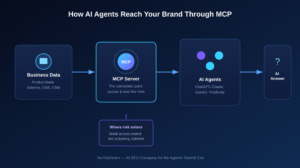
This is not a future problem. It is happening right now, across ecommerce catalogs, CRMs, knowledge bases, and content management systems worldwide. And it is reshaping two things at once: enterprise security, and how brands show up in AI search. This is exactly the kind of shift an AI SEO company should be tracking before clients ask about it.
Anthropic introduced MCP in late 2024 to solve a simple problem. AI agents like Claude, ChatGPT, and Gemini needed a standard way to connect to outside tools instead of custom code for every integration. Think of it as a universal adapter. One AI agent, thousands of possible tools, one shared protocol.
Adoption took off fast. OpenAI, Google, and Microsoft all built support for it. Thousands of public MCP servers now exist, connecting AI agents to everything from Slack and GitHub to internal company databases and ecommerce platforms.
That is the upside. Here is the part fewer people are talking about.
MCP was designed to make AI agents more capable fast, not to be secure by default. Security researchers have flagged several real attack patterns already in the wild:
The Wiz Academy and multiple enterprise security teams now list MCP among the top emerging risks for organizations adopting agentic AI. A major protocol update in 2026 openly acknowledges this, shifting more security responsibility onto the businesses deploying it.
Here is where this stops being purely an IT story.
AI agents are becoming a real discovery channel. When someone asks ChatGPT, Perplexity, or Google AI Overviews about a product, a service, or a company, that agent may be retrieving live structured data instead of just reading a static page. If that retrieval happens through an MCP connection, the accuracy and security of that connection directly affects what gets said about your brand. This is why more brands are bringing in an AI SEO company instead of relying only on a traditional agency for this layer of work.
MCP is becoming core infrastructure for how AI agents interact with the web, and enterprise security teams are already treating it as a major new risk category. For anyone working in SEO, AEO, or GEO, or for any AI SEO company advising brands right now, the opportunity is to get ahead of it. Visibility in AI search is no longer just about content quality. It is about the integrity of the entire data pipeline behind that content, including protocols like MCP that most brands have never even heard of.
The businesses that treat structured data governance as part of their SEO strategy today, with the right AI SEO company guiding that work, will be the ones AI agents trust tomorrow.